Where we have got to
Model fitting and inference for infectious disease dynamics
Have the chains converged?
Straight, plump at both ends, several chains on top of each other. compares the variance between chains with the variance within them. We want this to be below 1.01.
Before you see the data
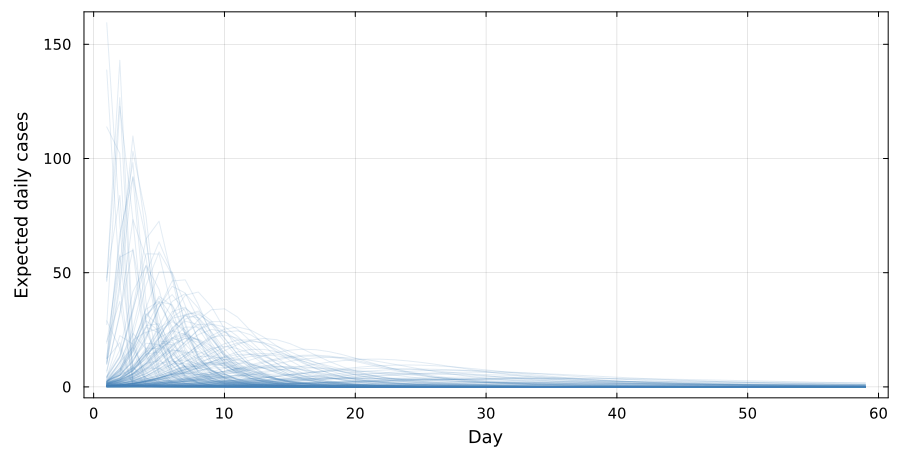
Two hundred draws from our priors. Most burn through the population in a week.
After fitting
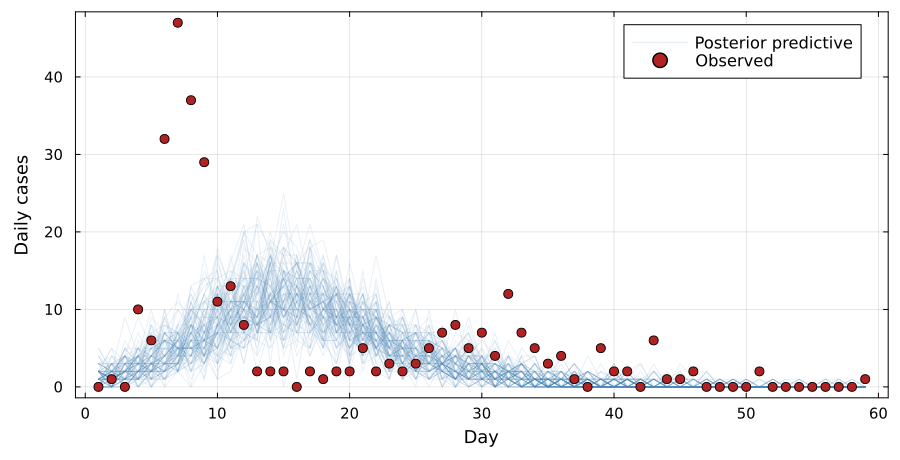
The fit misses both waves: a flatter, later, smaller epidemic that splits the difference between them.
A stochastic model makes the likelihood an integral

Run a stochastic model twice and you get two different trajectories. One no longer gives one curve to hold against the data; it gives a distribution of them, and the likelihood is the average over that distribution. Estimating that average, for SEIT4L, is where today starts.